

Electric Actuator vs Solenoid Valve vs Electric Motor: Key Differences and Applications
- Industrial Automation / Actuators
- Nov 18, 2026
- 12 Views
Electric Actuator vs Solenoid Valve vs Electric Motor: Key Differences and Applications
Industrial automation uses different types of electrical devices to control machinery, operate valves and manage fluid flow. Electric actuators, solenoid valves and electric motors are three commonly used technologies in industrial systems.
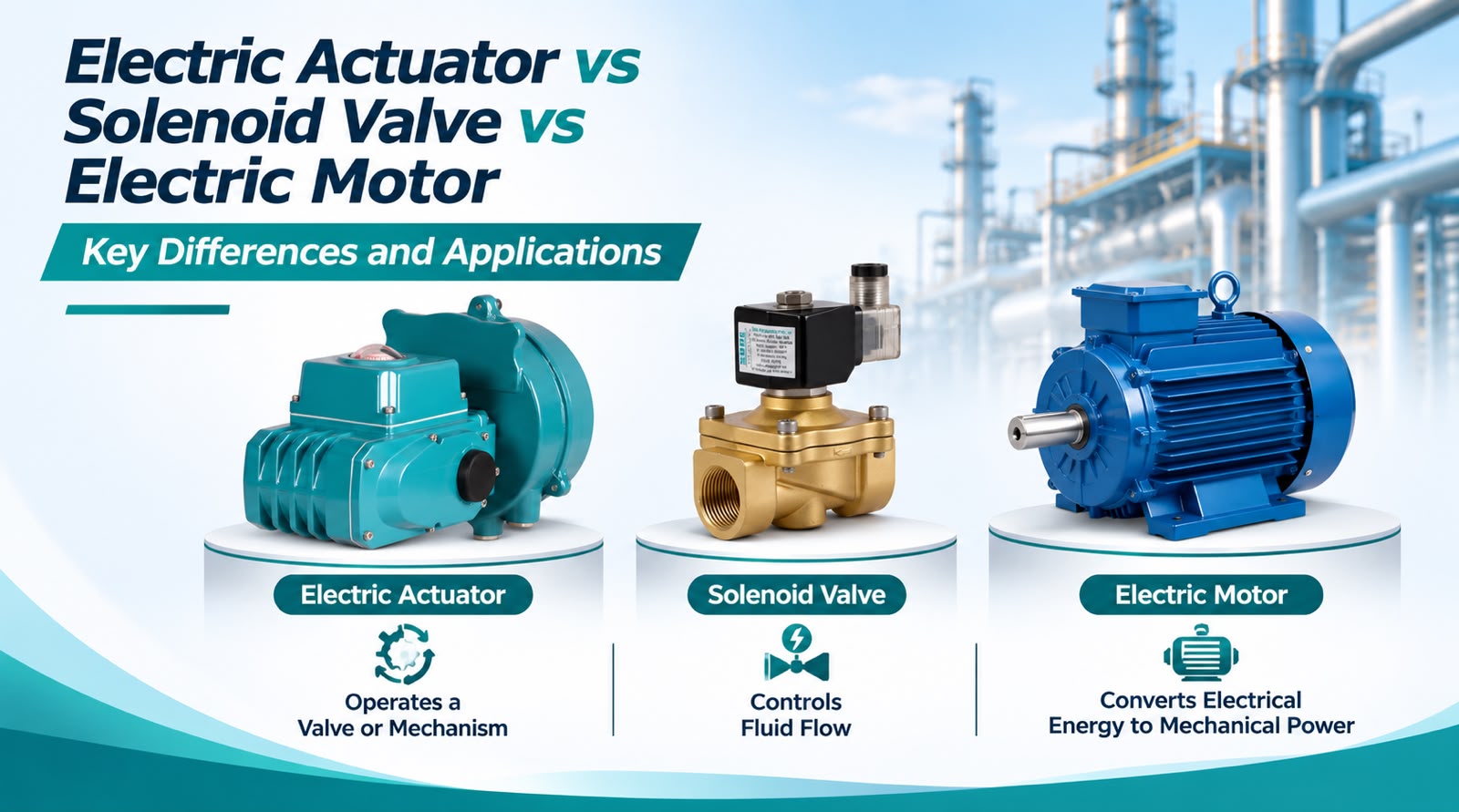
Although all three use electricity, they perform different functions. An electric actuator provides mechanical movement to operate a valve or damper. A solenoid valve uses electromagnetic force to control fluid flow. An electric motor converts electrical energy into mechanical energy and can serve as the driving component inside an actuator.
Understanding the differences between these devices helps engineers, plant operators and procurement professionals select the right equipment for their applications.
In this guide, we explain how electric actuators, solenoid valves and electric motors work, where they are used, and how to choose the right solution for industrial automation.
1. What Is an Electric Actuator?
An electric actuator is an electromechanical device that converts electrical energy into controlled mechanical movement.
In industrial valve automation, an electric actuator is mounted on a compatible valve to automate its opening, closing or positioning.
The actuator operates through an electric motor and a mechanical transmission system consisting of components such as gears, shafts and control mechanisms.
Depending on its design, an electric actuator can provide:
Quarter-turn movement
Multi-turn movement
Linear movement
Angular movement
On-off operation
Modulating valve positioning
Electric actuators are commonly used with ball valves, butterfly valves, gate valves, globe valves, dampers and other compatible mechanisms.
How Does an Electric Actuator Work?
The basic working process involves the following steps:
Electrical input: The actuator receives power and an operating command from a local control station, PLC, DCS or another compatible controller.
Motor operation: The internal electric motor starts rotating in the required direction.
Mechanical transmission: Gears and other transmission components transfer the motor's movement to the output mechanism.
Valve movement: The output operates the connected valve or damper.
Position control: Limit switches, position controllers or feedback devices help control and monitor the required operating position, depending on the actuator configuration.
This arrangement allows industrial valves to operate remotely and automatically.
Applications of Electric Actuators
Electric actuators are widely used in:
Water and wastewater treatment plants
Oil and gas facilities
Chemical and petrochemical industries
Power generation plants
HVAC systems
Pharmaceutical manufacturing
Food processing
Industrial pipelines
Marine and offshore installations
They are particularly useful when valves require remote operation, controlled positioning, higher operating torque or integration with industrial automation systems.
Explore the SDTORK Electric Actuator Range to understand the different quarter-turn, multi-turn and linear actuator configurations available for industrial valve automation.
2. What Is a Solenoid Valve?
A solenoid valve is an electrically operated valve that uses an electromagnetic coil to control the movement of an internal plunger or valve mechanism.
When electrical power is supplied to the coil, it generates a magnetic field. This magnetic field moves the internal mechanism, allowing or preventing fluid flow through the valve.
When the electrical signal is removed, the valve typically returns to its normal position through a spring or another designed mechanism. Some solenoid valves use different operating arrangements, including latching designs.
Solenoid valves are generally used for relatively fast switching between defined flow states rather than providing the continuous mechanical positioning associated with many modulating electric actuator applications.
How Does a Solenoid Valve Work?
The operation can be explained in four stages:
Electrical signal: The solenoid coil receives an electrical supply.
Magnetic field: The energized coil generates an electromagnetic field.
Plunger movement: The magnetic force moves the internal plunger or armature.
Flow control: The movement opens or closes the valve passage, depending on the valve design.
When the electrical supply is removed, the mechanism returns to its designed normal state in a conventional spring-return configuration.
Types of Solenoid Valves
Normally Closed (NC): The valve remains closed when de-energized and opens when the coil is energized.
Normally Open (NO): The valve remains open when de-energized and closes when the coil is energized.
Direct-Acting Solenoid Valve: The electromagnetic force directly operates the valve mechanism.
Pilot-Operated Solenoid Valve: The solenoid controls a pilot passage, using fluid pressure to operate the main valve mechanism. These designs require suitable operating pressure conditions.
Applications of Solenoid Valves
Solenoid valves are commonly used in:
Pneumatic systems
Hydraulic circuits
Water distribution
Compressed air systems
Irrigation equipment
Fuel control systems
Industrial machinery
Automated dispensing equipment
Fluid handling systems
They are particularly suitable for applications requiring electrically controlled fluid switching.
3. What Is an Electric Motor?
An electric motor is a machine that converts electrical energy into mechanical energy, usually in the form of rotational movement.
It is a fundamental component of many industrial machines, pumps, fans, compressors, conveyors and electric actuators.
Unlike an electric actuator, a standalone electric motor does not automatically provide the complete valve operating mechanism, position control and mounting arrangement required for automated valve operation.
The motor provides the driving force, while additional mechanical and control components determine how that force is used.
How Does an Electric Motor Work?
An electric motor operates through the interaction of magnetic fields.
Its basic operation involves:
Electrical energy is supplied to the motor.
Current produces magnetic fields within the motor.
The interaction of magnetic fields generates torque.
The motor shaft rotates and delivers mechanical power to the connected equipment.
Different motor designs are available depending on the application.
Common Types of Electric Motors
AC Motors: Operate using alternating current and are widely used in industrial machinery.
DC Motors: Operate using direct current and are used in applications requiring suitable speed and torque control.
Induction Motors: Commonly used in industrial equipment because of their robust construction and practical operating characteristics.
Synchronous Motors: Operate at a speed related to the supply frequency and motor design.
Applications of Electric Motors
Electric motors are used in:
Industrial pumps
Air compressors
Cooling fans
Conveyors
Manufacturing machinery
Blowers
Mixers
Processing equipment
Electric actuators
An electric motor may form part of an actuator, but a motor by itself is not a complete electric valve actuator system.
4. Electric Actuator vs Solenoid Valve vs Electric Motor: Key Differences
The most important difference is their function.
An electric actuator provides controlled mechanical movement to operate a valve or mechanism. A solenoid valve directly controls fluid flow through electromagnetic operation. An electric motor produces mechanical power to drive connected machinery.
Comparison Table
Parameter | Electric Actuator | Solenoid Valve | Electric Motor |
|---|---|---|---|
Primary function | Operates a valve or mechanism | Controls fluid flow | Produces mechanical power |
Operating principle | Motor and mechanical transmission | Electromagnetic force | Electromagnetic motor action |
Main output | Rotary, multi-turn or linear movement | Valve opening or closing | Shaft rotation |
Position control | On-off or modulating, depending on design | Generally defined switching states | Depends on motor and drive system |
Typical use | Automated valve operation | Fluid switching | Machinery and equipment drive |
Valve compatibility | Designed for compatible valves | Integrated valve assembly | Requires suitable additional mechanism |
Feedback | Available in selected configurations | Depends on valve and system | Depends on additional sensors or control equipment |
Common applications | Pipelines, process plants, HVAC | Pneumatic, hydraulic and fluid systems | Pumps, fans, conveyors and machinery |
5. Electric Actuator vs Solenoid Valve: Which Is Better?
These devices are not direct substitutes in every application. The right choice depends on what the system needs to control.
Choose an Electric Actuator When:
A large industrial valve requires automated operation.
The application requires higher operating torque or thrust.
Remote opening and closing are necessary.
Intermediate valve positioning is required.
Modulating control is needed.
The valve must integrate with a PLC or DCS.
Multi-turn or linear valve movement is required.
Choose a Solenoid Valve When:
A fluid passage needs simple electrical switching.
Fast opening and closing are required.
A compact valve assembly is preferred.
The application involves pneumatic or hydraulic control.
The fluid flow requirements are compatible with available solenoid valve designs.
The required operating pressure and electrical specifications are satisfied.
Practical Example
Consider an industrial water treatment plant.
A large butterfly valve controlling the main pipeline may require an electric actuator because it needs mechanical torque to rotate the valve disc.
However, a smaller water or pneumatic control line may use a solenoid valve to switch fluid flow based on an electrical command.
Both devices can work within the same automated system, but they perform different jobs.
6. Electric Actuator vs Electric Motor: Understanding the Difference
An electric motor is a driving component, whereas an electric actuator is a complete mechanical and electrical assembly designed to produce a required movement.
An actuator commonly incorporates an electric motor along with gearing, output components and control arrangements.
Electric Motor
A standalone electric motor produces rotational movement.
Its output is typically described through parameters such as:
Power rating
Rated voltage
Speed
Torque
Current
Frequency
Electric Actuator
An electric actuator uses a motor and additional components to deliver controlled movement to a valve or mechanism.
Its selection may involve:
Required valve torque or thrust
Operating angle or stroke
Operating time
Control mode
Duty cycle
Position feedback
Valve mounting arrangement
Therefore, when automating an industrial valve, selecting a motor alone is not the same as selecting a suitable electric actuator.
7. Types of Electric Actuators Used in Industrial Automation
Electric actuators are available in different configurations to suit different valve operating mechanisms.
Quarter-Turn Electric Actuators
Quarter-turn actuators provide approximately 90-degree rotary movement.
They are commonly used with:
Ball valves
Butterfly valves
Plug valves
Rotary dampers
They are suitable for applications requiring limited-angle movement and may support on-off or modulating operation depending on the model.
Multi-Turn Electric Actuators
Multi-turn actuators provide multiple rotations of the output shaft.
They are commonly used with:
Gate valves
Globe valves
Sluice gates
Other multi-turn valve arrangements
They are suitable for applications requiring several rotations to complete the valve travel.
Linear Electric Actuators
Linear actuators produce straight-line movement.
They are used with:
Globe valves
Diaphragm valves
Dosing pumps
Linear control mechanisms
Compatible damper arrangements
The actuator must provide the required thrust and stroke for the application.
Explore the SDTORK Electric Actuator Range to understand the different actuator configurations available for industrial valve automation.
8. Applications Across Different Industries
Oil and Gas
Electric actuators are used for automated valve operation in pipelines, processing systems and selected isolation applications.
Solenoid valves may be used in pneumatic control circuits and other auxiliary systems.
Electric motors independently drive pumps, compressors and other machinery.
Water and Wastewater Treatment
Electric actuators can automate valves in water distribution, filtration and treatment systems.
Solenoid valves can control smaller fluid passages, while electric motors operate pumps and other equipment.
Chemical and Petrochemical Industries
Electric actuators support automated process valve operation where torque, positioning and remote control are required.
Solenoid valves can be used in suitable fluid control and instrument systems.
Power Generation
Electric actuators can automate valves in auxiliary and process systems. Electric motors drive pumps, fans and other rotating equipment.
HVAC Systems
Electric actuators can operate dampers and compatible valves for airflow and process control.
Solenoid valves and electric motors are also used in selected refrigeration, fluid and ventilation equipment.
9. Factors to Consider Before Selecting the Right Device
Before purchasing equipment, engineers should evaluate the application and operating conditions.
1. Application Requirements
Determine whether the system needs valve positioning, simple fluid switching or mechanical power for machinery.
2. Valve or Equipment Type
Identify the equipment being operated and its mechanical requirements.
3. Torque or Thrust
For electric actuators, verify the required torque or thrust under actual operating conditions.
4. Flow and Pressure Conditions
For solenoid valves, check fluid compatibility, pressure range, flow capacity and differential pressure requirements.
5. Electrical Supply
Verify voltage, phase, frequency, current and electrical compatibility.
6. Control Requirements
Determine whether the application requires on-off operation, modulating control, position feedback or remote operation.
7. Environmental Conditions
Consider moisture, dust, temperature, corrosion and hazardous-area requirements.
8. Maintenance and Operating Frequency
Evaluate expected operating cycles, service requirements and accessibility.
Selecting equipment according to these parameters helps avoid incorrect sizing and operational problems.
10. Frequently Asked Questions
What is the main difference between an electric actuator and a solenoid valve?
An electric actuator operates a connected valve or mechanism using controlled mechanical movement. A solenoid valve uses electromagnetic force to open or close its internal flow passage.
Can an electric motor be used as a valve actuator?
An electric motor can provide the driving power, but a suitable mechanical transmission, valve interface and control arrangement are also required to create a complete valve actuator system.
Is a solenoid valve better than an electric actuator?
Neither is universally better. Solenoid valves are suitable for compatible applications requiring electrical fluid switching, while electric actuators are suitable for automated valve movement, higher torque requirements and applications requiring positioning.
Can electric actuators provide modulating control?
Yes. Electric actuators with suitable control electronics and positioning arrangements can move compatible valves to intermediate positions.
Where are electric actuators commonly used?
They are used in oil and gas, water treatment, power generation, chemical processing, HVAC, pharmaceutical and other industrial applications.
Do electric actuators contain electric motors?
Yes. Most motor-operated electric actuators use an electric motor as their driving component, combined with gearing, mechanical transmission and control components.
Are solenoid valves used in pneumatic systems?
Yes. Solenoid valves are widely used to control compressed air and operate pneumatic cylinders and other pneumatic equipment.
Conclusion
Electric actuators, solenoid valves and electric motors all play important roles in industrial automation, but they perform different functions.
Electric actuators automate the movement of valves and dampers. Solenoid valves control fluid flow through electromagnetic operation. Electric motors generate mechanical power for industrial machinery and can also serve as the driving component inside an electric actuator.
Understanding these differences helps engineers select the correct equipment based on valve type, operating force, flow requirements, control mode and installation conditions.
For industrial valve automation, explore the SDTORK range of quarter-turn, multi-turn and linear electric actuators designed for different valve applications and operating requirements.
Looking for an electric actuator for your industrial valve application?
Contact SDTORK Controls Pvt. Ltd. to discuss your valve type, torque or thrust requirements, operating conditions and automation needs.
Electric Actuator Range: https://www.sdtork.com/products/actuators
Contact SDTORK: https://www.sdtork.com/public/index.php/contact
Related published blog for future cross-linking:
Electric Actuator Communication Protocols: Modbus, Profibus and HART Explained
Related Posts
- Nov 30, 2026
- SDTORK
- 10
Electric Actuator Price in India: Factors Affecting Cost and Selection
Explore More
- Nov 27, 2026
- SDTORK
- 10