

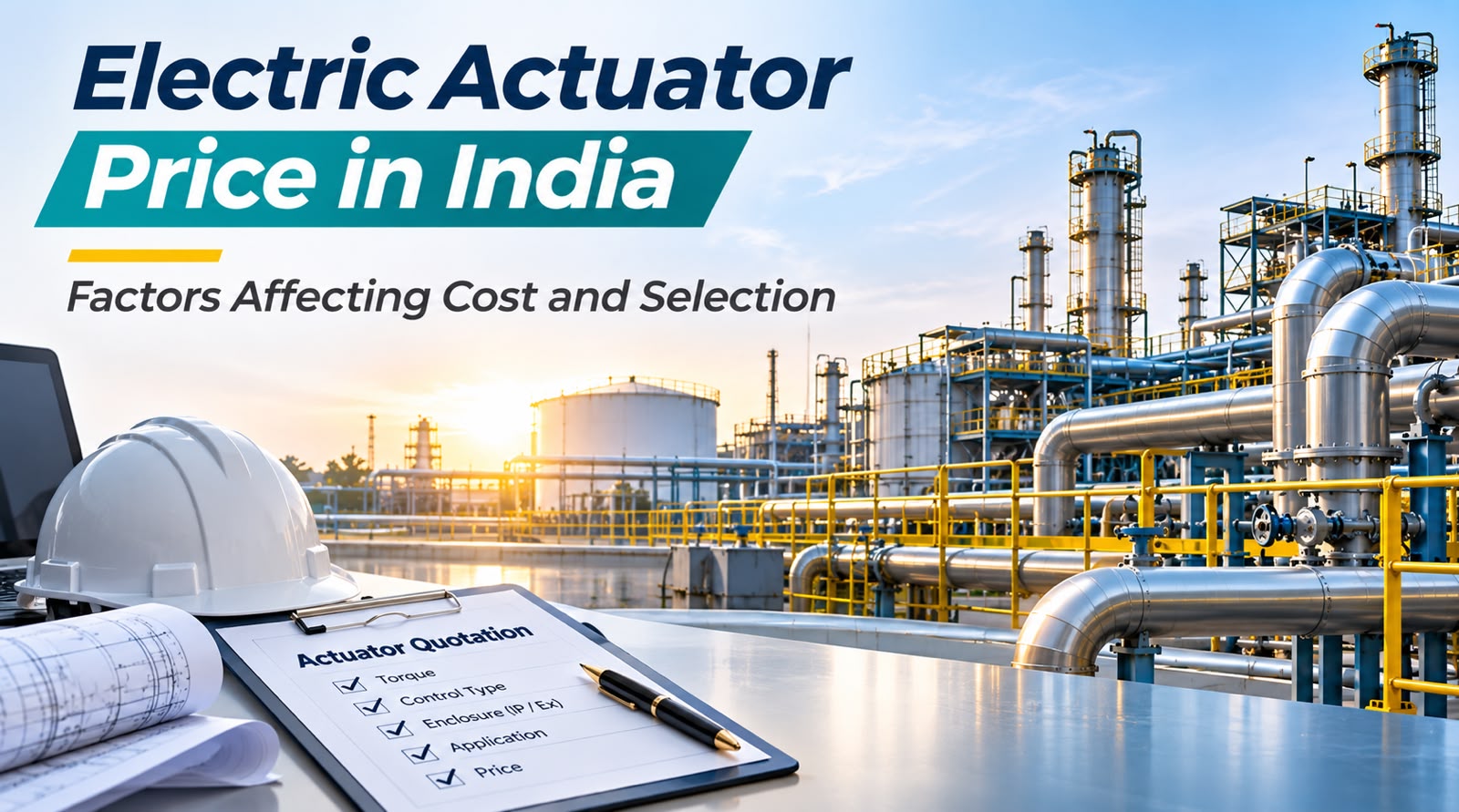
Electric Actuator Price in India: Factors Affecting Cost and Selection
- Industrial Automation / Actuators
- Nov 30, 2026
- 17 Views
Electric Actuator Price in India: Factors Affecting Cost and Selection
Electric actuators are essential components of modern industrial valve automation. They are used in water treatment plants, power stations, chemical industries, oil and gas facilities, manufacturing plants and several other process industries.
For businesses planning to automate industrial valves, one of the first questions is: What is the price of an electric actuator in India?
The answer depends on several technical and commercial factors. Actuator torque, valve type, operating mechanism, motor configuration, control requirements, enclosure protection and hazardous-area certification can all influence the final cost.
A small quarter-turn actuator used for a basic valve application will have different requirements from a high-torque multi-turn actuator designed for demanding industrial operations.
Understanding these factors helps engineers, plant managers, EPC contractors and procurement teams compare quotations and select the right actuator without compromising performance or reliability.
In this guide, we explain the factors affecting electric actuator prices in India, the differences between actuator types and how to choose the right solution for your application.
1. What Is the Price of an Electric Actuator in India?
There is no single fixed price for an industrial electric actuator because different applications require different technical configurations.
The cost depends on the actuator's output torque or thrust, operating mechanism, motor specifications, control system, enclosure protection and additional accessories.
For general market planning, third-party market estimates indicate that compact actuators may fall in the approximate ₹8,000–₹40,000 range, while industrial-duty models can range from approximately ₹50,000 to ₹5,00,000 or more.
These are broad indicative market estimates, not SDTORK's official selling prices or a guaranteed quotation. Specialized high-torque, flameproof, fail-safe and engineered actuator packages may cost considerably more.
The actual price must be confirmed against the required model, technical specification, quantity and supply scope.
2. Major Factors Affecting Electric Actuator Price in India
Several technical factors influence the price of an electric actuator.
A. Torque and Thrust Requirements
Torque is one of the most important factors affecting actuator cost.
The actuator must generate sufficient output torque to operate the connected valve under actual process conditions.
Higher torque requirements may involve:
Larger motors
Stronger gear arrangements
Heavier mechanical components
Higher-capacity output drives
Additional engineering requirements
For linear actuators, thrust rather than rotational torque is the primary output consideration.
Before requesting a quotation, determine the required valve torque or thrust from the valve manufacturer's data.
B. Type of Electric Actuator
Different actuator configurations have different mechanical designs and applications.
Quarter-Turn Electric Actuators
Quarter-turn actuators provide approximately 90 degrees of rotational movement.
They are commonly used with:
Butterfly valves
Ball valves
Plug valves
Industrial dampers
Their price depends on torque capacity, motor design, control mode and enclosure configuration.
Multi-Turn Electric Actuators
Multi-turn actuators provide multiple rotations of the output shaft.
They are commonly used with:
Gate valves
Sluice gates
Compatible globe valves
Other multi-turn valve arrangements
Gearbox requirements and output torque can significantly influence the final cost.
Linear Electric Actuators
Linear actuators provide straight-line movement or thrust.
They are commonly used with:
Globe valves
Diaphragm valves
Control valve mechanisms
Dosing equipment
Their pricing depends on thrust capacity, stroke length, operating speed and control requirements.
C. Weatherproof and Flameproof Construction
Environmental protection is another important cost factor.
Weatherproof electric actuators are designed to protect internal components against specified dust and water exposure.
Flameproof actuators are designed for suitable hazardous-area installations and require appropriate explosion-protection certification.
The cost of a flameproof configuration can be higher because of its specialized enclosure design, certification requirements and associated electrical components.
Buyers should verify the exact hazardous-area classification, gas group, temperature class and certification before selecting a flameproof actuator.
An IP protection rating alone does not establish explosion protection.
D. Motor Type and Electrical Supply
The motor is a major component of an electric actuator.
Different models may use synchronous stall-duty motors or squirrel-cage induction motors, depending on their design and application.
Price can vary according to:
Motor capacity
Single-phase or three-phase supply
Voltage requirements
Frequency
Thermal protection
Operating duty
Motor construction
The electrical supply must match the available power and the actuator manufacturer's specifications.
E. Control Mode: On-Off, Inching and Modulating
The required control mode also affects actuator configuration.
On-Off Control
On-off actuators move the valve between defined open and closed positions.
They are suitable for isolation and basic flow switching applications.
Inching Control
Inching operation allows the actuator to move in short controlled intervals.
It is useful in applications requiring intermediate positioning through suitable control arrangements.
Modulating Control
Modulating actuators support proportional positioning based on a control signal.
They are used in applications requiring controlled flow, pressure or process regulation.
Additional positioner electronics, feedback devices and control components can increase the overall actuator cost.
F. Position Feedback and Communication Features
Some industrial applications require more than basic open and close commands.
Additional features may include:
Open and close limit indication
Intermediate position feedback
Potentiometer feedback
4–20 mA position transmission
Remote control interfaces
Communication protocol compatibility
Fault indication
These features help integrate actuators with PLC, SCADA and DCS systems.
The final price depends on the number and type of electronic components and communication features required.
G. Gearbox and Output Configuration
Gearboxes are used when the application requires a different output torque, speed or mechanical arrangement.
Common configurations include:
Worm gearboxes
Bevel gearboxes
Supplementary gearboxes
Linear transmission units
The gearbox design, material, gear ratio and output capacity can influence the total actuator package cost.
H. Operating Environment
Industrial actuators may operate in demanding environments.
Factors such as dust, humidity, moisture, corrosion, vibration and ambient temperature influence the required construction.
An actuator designed for a clean indoor installation may not be suitable for an outdoor chemical plant or dusty cement facility.
Additional protection and construction requirements can affect the quotation.
3. Electric Actuator Price Comparison by Type
The following table explains the relative cost considerations for different actuator configurations.
Actuator type | Typical application | Main price factors |
|---|---|---|
Quarter-turn | Ball and butterfly valves | Torque, motor, controls |
Multi-turn | Gate and compatible globe valves | Torque, gearbox, duty |
Linear | Globe and diaphragm valves | Thrust, stroke, controls |
Weatherproof | Outdoor and industrial installations | IP protection, construction |
Flameproof | Classified hazardous locations | Certification, enclosure |
Modulating | Process control applications | Positioner, feedback, electronics |
There is no universal price applicable to every category. Two actuators of the same type can have significantly different quotations because of their technical specifications.
4. SDTORK Electric Actuator Range and Available Configurations
SDTORK Controls Pvt. Ltd. offers different electric actuator configurations for industrial valve automation.
Its product portfolio includes quarter-turn, multi-turn and linear electric actuators with different torque and thrust capacities.
Some published product configurations include:
SD-1000 Series
Weatherproof quarter-turn electric actuators with published torque ratings of 30 Nm and 50 Nm for the dome-type version, and 100–200 Nm for another configuration.
SD-1001 Series
Weatherproof quarter-turn electric actuators available in different torque configurations, including 60 Nm to 500 Nm variants.
SD-1001-ECO Series
Weatherproof quarter-turn electric actuators with a published torque range extending from 30 Nm to 2,000 Nm, depending on configuration.
SD-3000 Series
Multi-turn weatherproof electric actuators with published torque ratings starting from 20 Nm and extending up to 300 Nm.
SD-3000 with Supplementary Gearboxes
Available with supplementary worm or bevel gearbox arrangements to meet different output torque requirements.
SD-2000 Series
Linear electric actuators designed for compatible globe valves, diaphragm valves and dosing pumps, with published thrust configurations of 200 kg, 600 kg and 1,000 kg.
FSD Flameproof Series
Flameproof electric actuator configurations for applications requiring suitable hazardous-area protection.
The actual price of each configuration depends on the selected model, output requirements, accessories and technical specifications.
Explore the complete SDTORK Electric Actuator Range to compare available configurations.
5. Hidden Costs to Consider When Buying an Electric Actuator
The purchase price is only one part of the overall project cost.
Before comparing supplier quotations, consider the complete supply and installation requirements.
A. Mounting and Coupling Accessories
Some installations require additional mounting brackets, couplings, adaptors or mechanical modifications.
B. Electrical Wiring and Installation
Cable selection, cable glands, electrical connections and installation labour may be charged separately.
C. Control Panel and Automation Integration
PLC connections, control panels, feedback wiring and commissioning may add to the project cost.
D. Testing and Documentation
Some projects require inspection reports, test certificates, technical documentation and customer-specific quality checks.
E. Spare Parts and Maintenance
Consider the availability of replacement components, technical support and servicing.
Comparing the complete supply scope helps prevent unexpected costs after the actuator is purchased.
6. How to Choose the Right Electric Actuator Without Overspending
Selecting an actuator purely on the basis of its price can create problems during installation and operation.
A structured selection process helps balance technical performance and cost.
Step 1: Identify the Valve Type
Determine whether the application requires a quarter-turn, multi-turn or linear actuator.
Step 2: Calculate the Required Torque or Thrust
Obtain the operating torque or thrust from the valve manufacturer.
Consider the maximum opening and closing requirements and the appropriate engineering sizing allowance.
Step 3: Define the Operating Duty
Determine whether the actuator will operate in on-off, inching or modulating mode.
Step 4: Confirm the Power Supply
Check voltage, phase and frequency requirements.
Step 5: Select the Correct Enclosure
Identify whether weatherproof or certified flameproof construction is required.
Step 6: Define Control and Feedback Requirements
Determine whether local controls, remote operation, PLC integration, position feedback or communication protocols are necessary.
Step 7: Compare Complete Quotations
Compare the same technical specifications, accessories, documentation, warranty and supply scope across suppliers.
For detailed sizing guidance, read our related article:
How to Select and Size an Electric Actuator: Torque Calculation Guide.
7. What Information Is Required to Get an Electric Actuator Quotation?
Providing accurate technical details helps manufacturers recommend the correct actuator and prepare a suitable quotation.
Before contacting a supplier, prepare the following information:
Parameter | Information required |
|---|---|
Valve type | Ball, butterfly, gate, globe, etc. |
Valve size | Nominal diameter (DN) |
Movement | Quarter-turn, multi-turn or linear |
Torque | Required output torque in Nm |
Thrust | Required output thrust, if applicable |
Pressure | Operating and differential pressure |
Temperature | Operating and ambient temperature |
Power supply | Voltage, phase and frequency |
Control mode | On-off, inching or modulating |
Feedback | Limit switches, potentiometer or 4–20 mA |
Protection | Weatherproof or flameproof |
Quantity | Number of actuators required |
Providing these details helps reduce specification errors and unnecessary quotation revisions.
8. Why Consider SDTORK for Electric Actuators in India?
SDTORK Controls Pvt. Ltd. manufactures electric actuators for industrial valve automation applications.
Its product portfolio covers multiple actuator configurations designed for different valve types and operating requirements.
The range includes:
Quarter-turn electric actuators
Multi-turn electric actuators
Linear electric actuators
Weatherproof actuator configurations
Flameproof actuator configurations
Supplementary gearbox arrangements
Different configurations are available for applications across water treatment, power generation, chemical processing, oil and gas, HVAC, cement, sugar and other industrial sectors.
Rather than selecting a model based only on its listed torque or purchase price, buyers should evaluate the complete technical requirements of their application.
Visit the SDTORK website to explore its industrial electric actuator range and available product configurations.
9. Frequently Asked Questions
What is the average electric actuator price in India?
Electric actuator prices vary according to torque, actuator type, motor, control features, enclosure protection and certification. Compact models may cost considerably less than large industrial or specialized
Related Posts
- Nov 27, 2026
- SDTORK
- 10
Electric Actuators for Hydrogen and Defence Applications: Requirements and Selection
Explore More
- Nov 23, 2026
- SDTORK
- 10